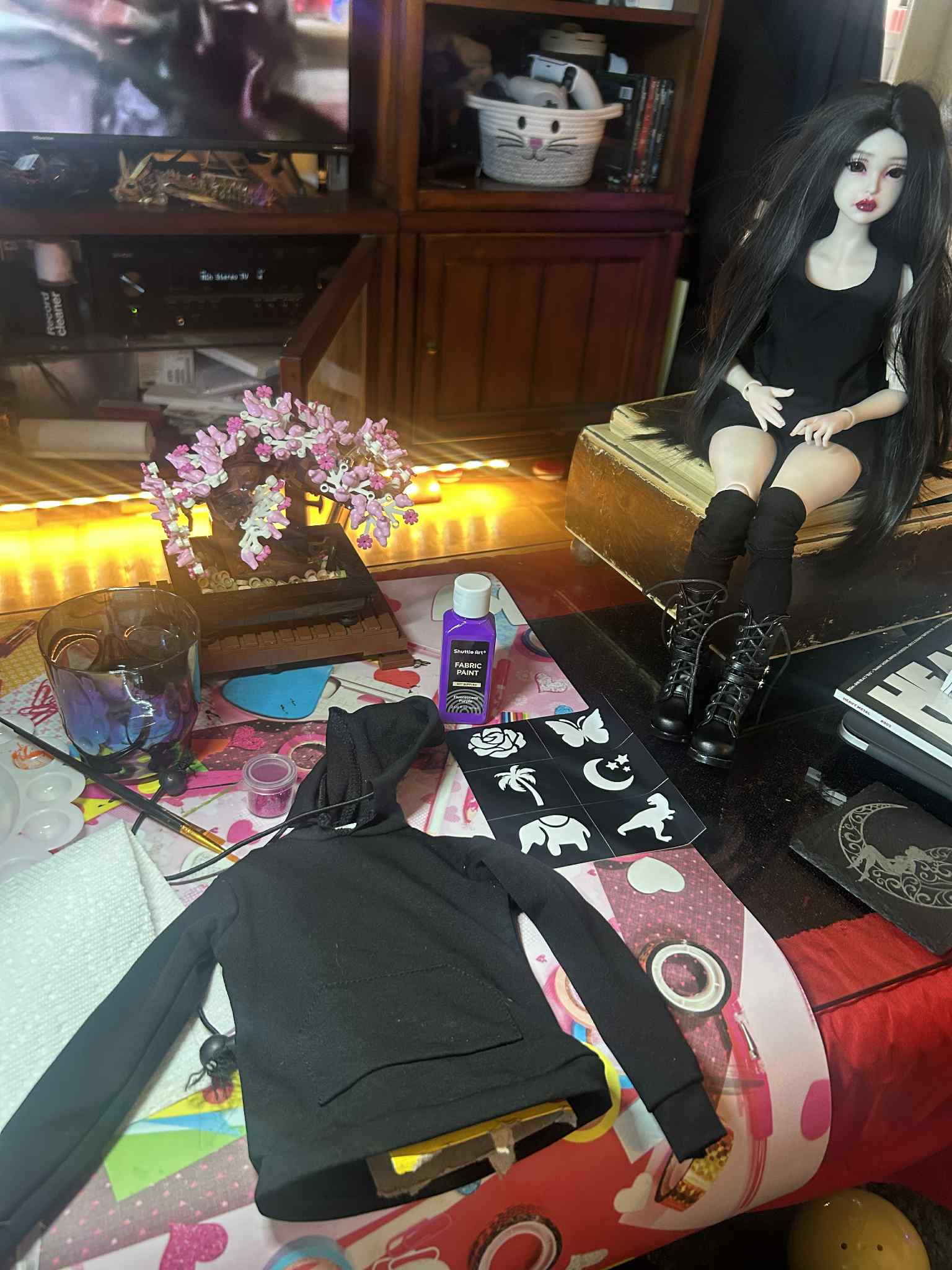
I decided that the hoodie I bought for Elizabeth needed a bit of fancying up! I’ve been watching a lot of Rattus Rattus on Youtube and they do a ton of customization of both doll stuff and people stuff so I felt both inspired and brave. Usually, what keeps me from trying something is the fear that it will all go wrong and I’ll be upset, frustrated, and out of pocket for whatever the cost was.
The fabric paint that I bought online to add a jack-o-lantern face to a tank top (thanks, Rabbit!) also came with a few stencils, so I reasoned that I couldn’t get into too much trouble if I used a stencil. I knew I wanted to add something purple, probably also with some glitter.
Here’s the basic black hoodie I bought online, with some cardboard pushed inside it to keep the fabric from bleeding. The butterfly stencil I chose (very early 2000s!) is ready to go and just needed to be peeled off the backing and stuck onto the hoodie. These stencils have a sticky back, which made it much easier! Elizabeth is supervising from a safe distance.
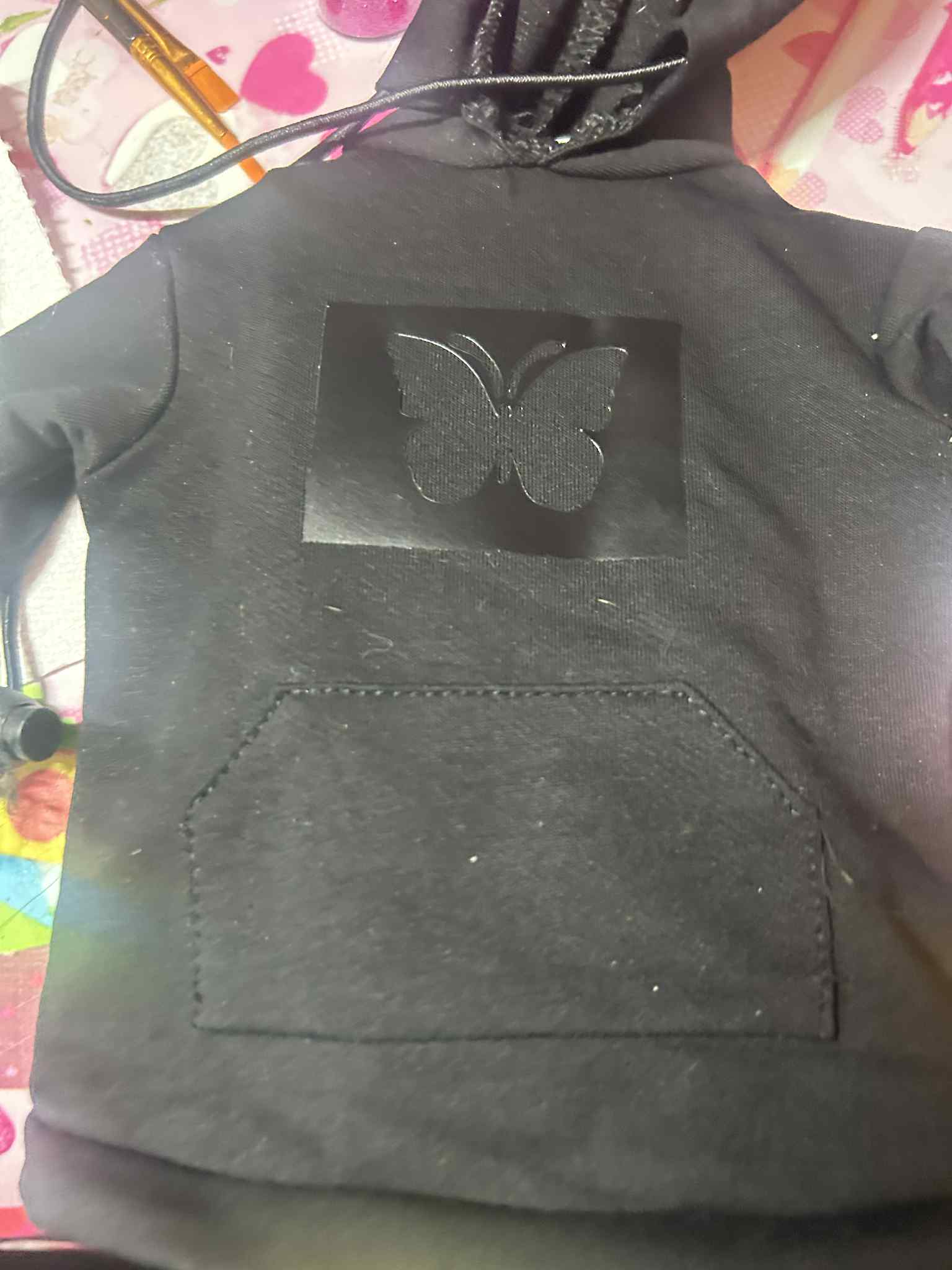
Stencil in place and ready to go! I think I picked this one because it reminds me of high school! I should make a human-sized one for myself.
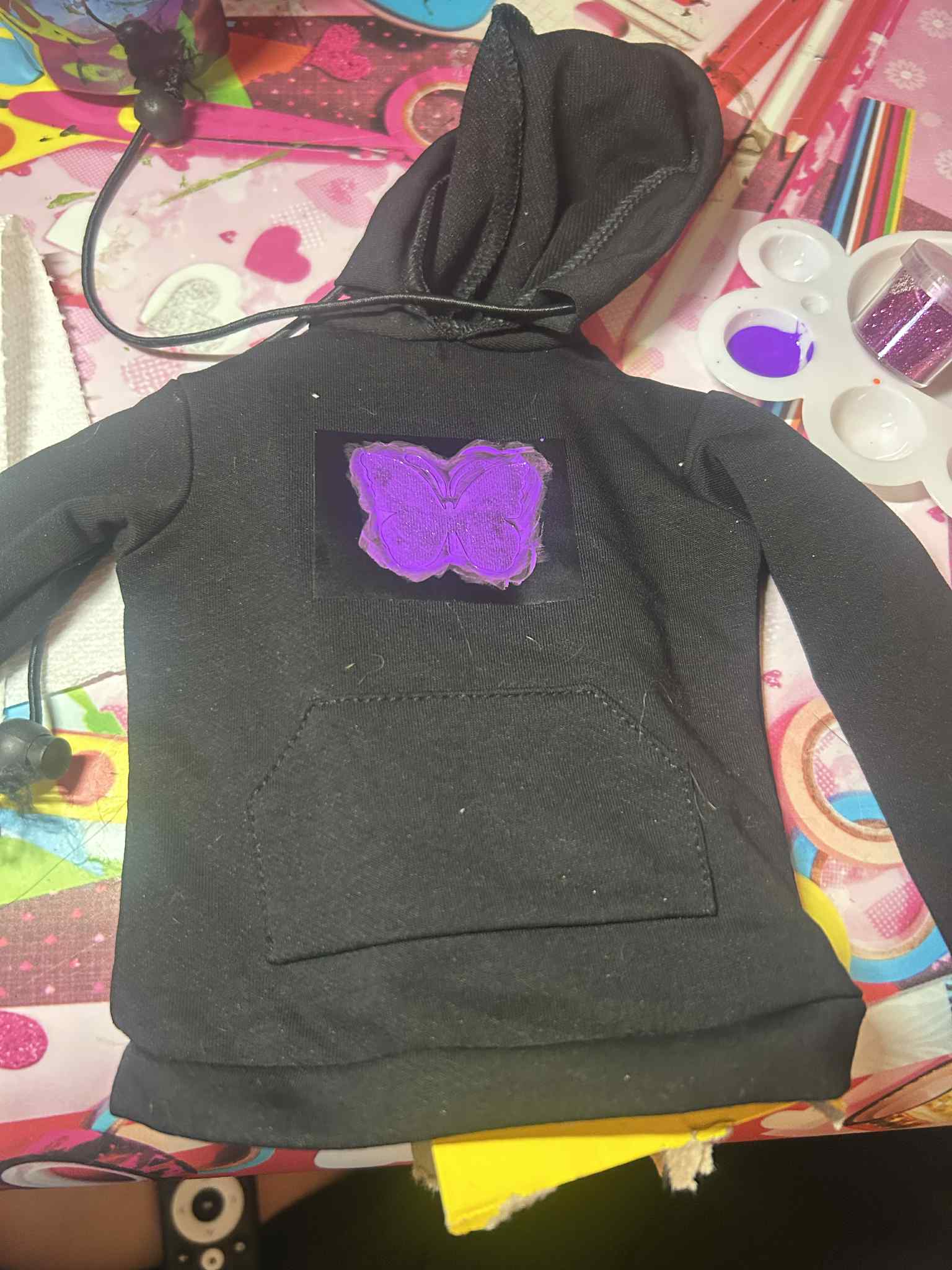
Here’s the paint process in action. It’s nothing too complicated. I think I ended up using three layers of paint. This stuff dried pretty quickly which meant that this didn’t take very long at all! I’ve also got my glitter picked out and ready to go!
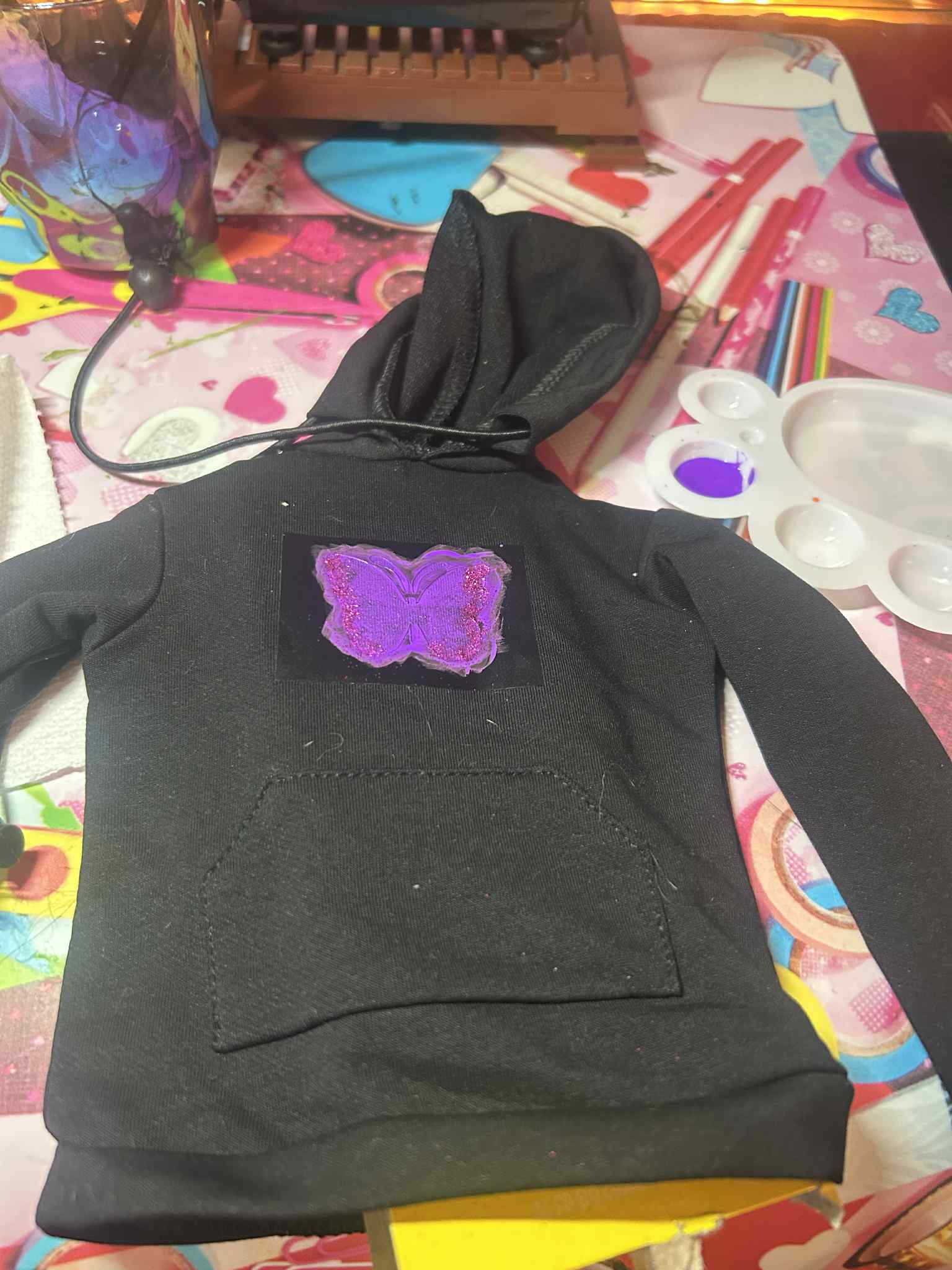
I did end up only putting glitter on the edges of the butterfly wings, because I thought it looked cuter but this is just personal preference. I kept the stencil on for this and used a paintbrush to apply the glitter only in the places where I wanted it. I don’t think I could have been so neat with it if I’d just dumped the glitter ~ I probably would have ended up covering the whole thing! Which would have also looked nice, I’m sure. It just wasn’t what I wanted.
I let the stencil dry all afternoon because I wasn’t in a hurry. I’m not sure exactly how fast the paint dried, but I doubt it took longer than an hour since my stencil was so small.
And here you can see the finished hoodie on Elizabeth! I’m very pleased with how it came out, I think it looks very sweet! I love that the paint isn’t perfect, I like it when things look unique or even hand-made!
In the end, I’m glad I took the plunge to customize this for my doll! She looks so pretty in it and now the hoodie makes me smile whenever I see it!
My cat is chasing June bugs. Her ears, like great sails, telegraphing her interest to the world. Her eyes are green and unblinking. My cat simply IS. It’s delightful, the clear and steady purpose of a cat. They sit, and the clouds go by, and the shadows creep. And throughout it all, they are CAT.
The séance had begun. Bernadine shifted nervously, petticoats rustling under her heavy wool skirt. The weather had turned cold these last few days and winter began to cast its tenebrous pall over the world. It matched the mood of the room chosen for the occasion.
The parlour had always been dark, even in high summer. Its heavy damask curtains and somber furniture made the room stately but morbid and somehow cold. The effect was heightened now that the curtains had been drawn, shutting out what paltry evening light there was. The room felt heavy and close.
Present was young Bernadine, her mother and uncle, the vicar, and the medium. This had all been her mother’s idea. Widowed many years ago, Adelina Harris had placed every hope for her family’s future on her son, Matthew. Matthew had been a difficult child – quarrelsome, selfish, and possessing an innate cruelty streak that quickly alienated both him and Bernadine from other children.
But Adelina had been desperate to cling to her son, who outwardly so resembled his father. That the boy had not inherited any of her husband’s great capacity for love and warmth never seemed to matter to her. She was a by her own nature, a proud and conceited woman whose less pleasant traits were tempered by her husband. He had died shortly after Bernadine’s birth, as if the universe had traded the two. Without her husband, Adelina’s vanity flourished, and little Mathew grew unchecked and wild, ruled by passions and indulged in every way by a mother who saw only her husband’s face when she bothered to see at all.
Bernadine had moved softly through childhood while being terrorized by her tyrannical brother. Matthew hit, broke toys, and stole cherished secrets. On entering adolescence, Bernadine was relieved to be sent away to a school for young ladies. She had thrived there, finally seeing that there was a world beyond her brother’s tiny kingdom.
Matthew grew as well. Where Bernadine became thoughtful, studious, and reasonably well-accomplished, he became twisted and malevolent, his only concern the indulgence of his own wants. There had been many fights, debts, and whispers of terrible things done to girls whose only misdeeds were to be born to lowly families. Money could buy silence and reputations could be repaired by moving the young beast to a different school.
Bernadine had always privately nursed suspicions about the nature of her brother’s end. Sensible and perceptive, she had always known that the day would come where money would no longer be enough. She had said as much to her mother years before and had been harshly reprimanded for her insinuations. Bernadine had watched her brother leave for university with a mixture of relief and foreboding. Glad to be rid of his odious presence, she still knew in her heart what was coming.
His first year had passed with more debts, more bad behaviour. Their uncle had been sent to speak with him. Matthew had laughed at the recriminations, no longer even pretending contriteness as he had in childhood. The uncle had spoken harshly to Adelina on his return, facing her with the damage her indulgences had done.
Adelina could no longer ignore the monster she had created. Her face began to show the strain her son’s behaviour was having on her finances and her soul. The laudanum helped but even so, she lost weight, her hair thinned and fell out, her wrinkles deepened.
The household had held its breath, waiting for the next blow. A scant few weeks in the winter term the news had struck. A messenger had brought a telegram. Adelina’s pallid hands shook and she wrestled with the heavy paper. Upon reading the contents she had fainted, landing on the hallway floor with a heavy thud. Matthew was dead.
The uncle again made the trek to his nephew’s living quarters. He had made a considerable effort to keep the horrifying details from Bernadine and her mother but it been necessary to mention a partial truth at least, to clarify the swirl of disturbing rumours.
Matthew had been found early one gloomy January morning, crumpled in a fetid alleyway. An obvious victim of foul play, his skull had been so badly beaten in that he was unrecognizable. The uncle had to resort to childhood scars to be certain it was his nephew who lay bloated and stretched on the morgue table.
It had been a devastating shock to Adeline. The golden child she had loved so well had breathed his last amongst the rotting garbage of a malodorous trash pile.
Bernadine had politely mourned her brother, the contemptable boy who had grown into an even more contemptable young man. Her outward sorrow did not touch her heart. She felt no genuine grief at the death of the person who had tormented her and so many others.
Adelina, far from feeling relief at her son’s death, seemed to be consumed by a sort of insatiable desperation. For a year Adelina continued to waste away, some maligning presence gnawing at her soul. She kept her son’s as he had left it. She laid out clothes for him in the morning. She even insisted on having a place set for him at Sunday dinner. Adelina seemed to take more notice of her dead son than she had ever bothered with while he lived. Bernadine suspected that it was guilt that drove her mother’s strange actions. Was it not the truth that Adelina’s blind spot had created the devilish passions that had ultimately killed Matthew?
Some months ago Adelina had met the medium. After her son’s death she had begun attending Spiritualist meetings at a local church, intent on finding a channel of communication to the hereafter. Adelina still possessed the kind of money that talked. Although Matthew’s death had somewhat rebuffed her vanity, she still intended to indulge her whims, even if it required unorthodox methods.
The result of this mania was the séance in which Bernadine found herself a less-than-willing participant.
Her uncle was here because he felt it his duty to protect his sister and niece. The pastor attended for the same reason, though he was less motivated by the paternal instinct of his office as he was by the potential loss of Adelina’s patronage to some other spiritual advisor.
The medium himself was a diminutive man, short and thin-limbed, he didn’t seem strong enough to hold the power he claimed. His most distinct feature was his heavy eyebrows. Thick and dark, they reminded Bernadine of miniature storm clouds perched against a high, sloping forehead. Their effect was highlighted by the darting, beetle- like eyes that took in the wealth of the parlour. He called himself Bellini.
All were seated around a small wooden table. On the table was a brass bell and a hand mirror. As they clasped hands Bernadine, sitting next to Bellini, felt a wave of revulsion wash over her. Not only because she didn’t care for the suggestive leers Bellini gave her on his arrival, she felt some primordial horror at what they were about to do. Would it not be better to let the dead sleep in their graves? Her brother, vile demon, could hardly be expected to improve in character given the sudden and violent nature of his death. Bernadine tried to ignore a tinge of nausea. Bellini had begun to speak.
“It is best to call the spirits to us with a hymn,” he explained. “They will know that we mean no harm and that they are welcome among us. Perhaps the young lady would be so kind?” He turned to Bernadine and she was glad that they darkness spared her the full effect of his lecherous, ingratiating smile.
Before she could beg off by claiming inadequacy, her mother spoke up “On yes, Bernadine has such a lovely voice!’’. Bernadine felt there was a sliver of desperation to her mother’s demeanor. Annoyed, she mentally sifted through the hymns she knew. If she was to be forced to sing, she would at least be sure to give them something close to her own feelings. Nothing merry or reverent. She began in her soft soprano ‘In the Bleak Midwinter’.
“Lovely, lovely!” Bellini praised. He instructed them all to keep holding hands and that the small mirror could be used as portal to call Matthew’s spirit out of the ether surrounding the living realm. Bellini began to call. “Mathew, Matthew Harris, come to us! Come back to your mother, Matthew. Your family misses you so!”
In the crepuscular light, Bernadine was sure she her uncle’s lips tighten at that last remark. There was no reply to Bellini and the parlour remained dark and still. The uncle was unimpressed and was convinced that Bellini was charlatan. “How long are we supposed to sit here?” he demanded peevishly. He was shushed by Adelina.
“The spirits do not perceive time as we do,” Bellini explained with ruffled dignity. “It may be some moments before Matthew makes his way out of the spirit world.”
The clock in the hallway ticked, each sound a punctuation of the silence in the room. Bernadine wasn’t sure which happened first, the terrible pressure in her chest or the brass bell emitting a single note, sharp and high though it had not moved. It echoed through the room and the entire group jumped.
“Madam, he is here!” cried Bellini. Adelina let out a trembling sigh, as if some great burden had finally been lifted. The uncle looked on dubiously, first at the bell and then at the vicar, who gave an almost imperceptible shrug of his shoulders. Bernadine’s chest grew tighter and her vision began to swim. The vicar gently squeezed her hand.
“What should we do?” Adelina asked with excitement.
“Make sure it really is your son,” the pastor said pointedly. Bellini shot him an annoyed look but the vicar pressed on “if it is as this man claims and we have called some poor soul out of a ghostly miasma, away from their eternal rest hadn’t we better make sure it is Matthew here and not something else?”.
Bernadine made of note of the vicar’s phrase ‘something else’ instead of ‘someone else’. Bellini was defiant. “I have powers far beyond those taught by the limits of your church!”, he sneered. “I have called Matthew Harris and so it is he who responds!”.
“Even so,” answered the vicar, rankled by the disparaging comments, “it could do no harm to be sure,”. He was determined to force Bellini to back down. Adelina must see the church’s ultimate authority over spiritual matters. There was no reason to be taken in by (or to support) such wastrels as the medium, Bellini.
The medium realized that he was corned and with a huff, asked the spirit to give some sign that it was Matthew Harris. As they waited the air in the room seemed to become heavy and oppressive, as if before some great thunderstorm. Bernadine began to feel dizzy again. All of a sudden, the smell of cheap cigar smoke was all around them, filling their nostrils with the sour, acrid scent. Adelina let out a shivering cry “oh it’s him! It’s my dear Matthew come home again!”. Bellini regarded both uncle and vicar with no small amount of smugness.
Bernadine noticed her uncle’s attention draw to the closed door of the parlour, listening intently to something. Before she could ask, Bernadine could hear it as well. Her stomach heaved in recognition; it was the sound of the back door slamming over and over, with such force that Bernadine was sure it would splinter to pieces.
Bellini’s face had changed. The smug confidence slipped and was replaced by confusion and trepidation.
“I must let my Matthew in,” Adelina announced with maniacal glee.
“You must stay at the table, the circle must remain unbroken,” the medium ordered. Adelina made to rise and go to the door anyways. “MADAM,” Bellini said with force “I insist that you remain in your seat!”. The uncle began to object to both Bellini’s tone and liberties in ordering Adelina. His words were cut off abruptly by the sound of the back door giving a final, enormous slam that vibrated through the house.
Bernadine felt panic rising quickly inside her very soul. Something felt terribly wrong. The vicar murmured a prayer under his breath. All attention was now fixed on the parlour door. The room filled with a sense of foreboding. Bernadine finally voiced the doubts that had plagued her all evening. “We should not do this. We should not disturb the dead in tier graves!”
“Heed the young lady,” said the vicar sardonically. “Bellini, what we do here is sacrilege.”
“It is only Matthew coming home to me!”. Adelina looked at the others condescendingly and slightly crazed.
“No mother,” whispered Bernadine. She looked to her uncle for re-assurance, but he remained fixated on the door.
There were more sounds now. An uneven sound of footsteps, it seemed as if whatever was making its way down the hallway was half-dragging itself on crippled limbs. The smell of cheap cigars seeped away into the scent of moist, stinking rot. The air was so foul that Bernadine felt her eyes burning and her throat close. She began to gag and the circle of hands was finally broken by Bernadine’s uncle helping her to lay on the nearby settee. The vicar produced some smelling salts and Bernadine was somewhat revived.
Adelina watched her daughter with contempt. “Stupid girl, it is only your brother”. Bellini seemed to gather himself from deep within. “Madam, I assure you it is not”. Adelina stared at him, confusion knitting its way across her forehead.
The muffled sounds continued and grew louder as whatever had been called from the other realm approached the parlour door. Bernadine glanced at the small table, “look,” she cried, pointing at the mirror. As they all watched, the mirror began to glow a sort of sickly blue. Dully at first and then with such intensity that tiny cracks appeared across the glass. The mirror exploded, sending shards in all directions.
“Stop this!”, the uncle demanded of the medium. “You’ve gone too far! Stop this immediately!”
“I don’t believe I can,” Bellini responded with fear underscoring his voice.
The sound of scrabbling came from the other side of the door, clumsy hands fumbling with the knob. “Oh, it’s here!”, Bernadine whispered in terror. The room swam, electric with dread. She was certain she would vomit and the smell was now unbearable. The door began to rattle. Adeline leaned forward, mewling about her returning boy and a disturbed smile splitting her face.
The door crashed open and hung drunkenly off its hinges, giving a wild frame to what waited in the doorway.
It was Matthew. Or what might have been Matthew if he had been conceived in nightmares. Corrupt and decaying, his limbs hung disfigured around him like a broken doll. The brute was mangled and blood stained, crusted with the glutinous liquid that gurgled from the mutilated mess that had once been a head.
Bernadine was out of her mind with horror and was only dimly aware that the shrieks ringing in her ears were her own. She was hardly conscious of anything other than her feeble, desperate attempts to get away from the abomination of flesh presenting itself as her brother. She barely heard the pitiful whimpers of Bellini or the shouted catechisms of the vicar. She was overwhelmed by the unnaturalness of what had been done. Her chest constricted again, and her terror was snuffed out as she faded into blackness.
The house still stands, though it has been vacant since that awful night. Shouting and an abhorrent smell had drawn neighbours into the street. Weird lights were seen flashing though windows and wind whipped up from nowhere. No one had dared approach and the police were sent for. By the time they arrived, the door opened and a pale, fainting Bernadine was led to a nearby cab by her uncle. After speaking with him, the police insisted everyone return to their homes.
Adelina Harris is buried in the churchyard next to her husband and, god-willing, the her son. The service was presided over by a haggard looking vicar.
The house is still and silent. The vicar will not speak of that night and Bellini has fled. Bernadine resides with her uncle while her nerves recover.
The house is still and silent. Though sometimes neigbours and passersby complain of a terrible smell; like rot and damp soil.
Fern knew these stories but out of necessity she had paid no attention. Or at least, she never had before. Since the sinking of the Augustina she thought she heard noises in the night. The noises were full of screams and cries and the deafening sound of splintering wood. She would check her window and listen but only heard the usual sounds of leaves rustling and the crash of the surf.
One week later, Fern laid down to bed. She slipped into a fitful sleep full of lightening and endless storm. She woke at midnight, though she didn’t know why. She lifted her head from her pillow and listened. The only sounds were of the quiet of the house. Her mother was asleep and her father was tending the light.
Laying tense as a wooden board, Fern strained her ears against the silence. Soon she heard something, it was quiet and muffled like it was far away or under water somehow. She listened, pale and afraid, and soon she could make the sound out to be a scream. Or rather, many screams.
No longer muffled, Fern could hear the terrifying cacophony of long, dolorous wails. She was sure the sound came from the water. As Fern lay trembling under her blankets, she heard the din burst up from the sea and rush towards the cottage. She heard the kitchen door crash open and suddenly the roaring was downstairs. The whole house began to shake and shudder with the suffering of those lost souls.
Fern froze in shock and dread as the mass rushed up the stairs and down the hallway. It erupted into her room and suddenly Fern was engulfed by it. The screams echoed all around her and she pushed her palms so hard to her ears that her hands turned white. With great awe, she realized she could make out individual voices.
“Oh God, no!”
“James, the baby!”
“I can’t breathe!”
“My legs, Jesus Christ, my legs!”
All of this wrapped by the sounds of sobbing so hard and loud that Fern’s chest began to ache. Helpless, her own screams joined in with the rest of them. Her bedroom seemed to swell and undulate as the restless souls howled their grief into her ears. Suddenly, there was a loud, crashing boom that made her head ring. Everything stopped.
Shaking, Fern moved her hands away from her hears. Nothing. No screaming, no wind, no sound of the world breaking open. Only the sounds of the sleeping house. The only evidence of the event were Fern’s reddened, tear-stained cheeks, and the pain in her throat from screaming. Even the bedroom door was still closed. Cautiously, the girl crept out of bed and down the hallway. Still nothing. She paused at the door to her parent’s bedroom and heard the deep breathing of her sleeping mother. Making her way downstairs, she found it was just as still. No screams, no broken furniture to explain the crashing she heard.
Fern crossed the room to the large window opposite. It looked out over the ocean and Fern had passed many happy afternoons watching the waves. Now, the window seemed to beckon her with a foreboding she couldn’t explain. Each step she took seemed mechanical, as if some outside force compelled her forward. Unease growing, she made her way to the window.
Throwing open the heavy curtains, Fern was greeted with an awesome scene of sublime terror. The waves were whipped to a fever pitch, rolling and crashing in barbaric frenzy. All manner of vessels were being slapped and beaten by swells. Helpless, they plunged under and rose again, endlessly floundering over and over. Everything in the fiendish presentation was lit in a sickly glow. Fern gasped as fear and shock forced her lungs to empty. Tears ran unchecked but she could not scream. Whatever held her chest held her between life and death, it had full command of her.
Forced to look, Fern realized with horror that she could see people as well. They dripped with wet and blood from ghastly injuries. On their broken and twisted limbs, with their skin rotting, they were dragged along the waves. When they screamed, Fern could see their teeth through ripped skin. Their clothing in savage disarray, they almost seemed to dance with the feral surf of the storming sea.
The girl at the window watched the lost souls perform their dance macabre. All the while, they heaved across the maelstrom, headed desperately towards the beam of the lighthouse, the valiant beacon that tried to bring them home.
Fern could bear no more and collapsed to the floor in a faint. Her mother found her there in the morning. Fern was pale and shivering. She would take to her bed for a week and when she emerged, she was always quieter thereafter.
As her mother had tucked her into bed, she reassured Fern that the sea had been calm overnight and her father’s watch was uneventful. Still, it was a long time before the spell of that night lost its power over Fern.
Ever after, in the early spring, she hears the voices of the lost, far out at sea as they struggle to make their way home.
She was supposed to come last week, Tuesday. She never arrived. No one was really surprised when she didn’t, those who live by the sea will never forget its raw power, but there was always hope. Hope it was that clung to the hearts of wave-battered Coll Vale, hope that the terrible storm had failed to bring down their ships with its wild fury.
Hope held out until dawn of the following day. Every boat accounted for except the steamship Augustina. She had been bound for Coll Vale with a cargo of miscellaneous goods; coal, tools, flour from the mill up the coast. The storm had hit, and she had never arrived in the small harbour. The residents of clucked and muttered with looks as dark and grim as the cold stone of the houses.
The gale had brewed during the night, cold and menacing. Wind whipped the sea into a great frenzy and rain lashed hard enough to rattle windows in their frames. Dawn broke, black, and moody. Fern watched the dark, roiling waves from the front steps of the ancient cottage by the lighthouse where her father was keeper. Her mother was just inside, busy in the small kitchen. She was always busy during brewing storms; her husband’s role was crucial to the tight-knit community. The lighthouse projected the only beacon that could guide souls safely into the protective embrace of the harbour. He would not leave his post until the storm subsided, no matter the day or night. Endless cups of coffee and hearty soup were the families’ weapons against the exhaustive hours and bone-gnawing cold. The light must never go out, whatever the cost.
Fern was first told this at age five, old enough to share the burden of her families’ occupation. Little Fern, on skinny legs, was tasked with bringing soup to her father during the night of a wicked summer storm. The morning had been red and stick, and the humidity rose all day. Her father had kept a worried eye on his barometer and as the mercury crept higher, he casually remarked that he thought it would be a long night. Her mother’s brow wrinkled as she pressed her lips together. After lunch she instructed Fern to climb the creaking ladder to the dirt basement and bring up carrots and potatoes. Fern, feeling put out, had whined. She was frightened of the basement in a vague, child-like way and besides, it was much to hot to light the stove.
Her mother rebuked her sharply. Her father would have no relief until the storm, staying with the light until danger had passed. It was their duty to keep shipping traffic safe, people and the good Lord were counting on it. Chided, Fern slunk off to obey her mother. She didn’t really understand, duty and souls in peril on the sea are very far away things to such a young girl. But she did understand her mother’s tone and felt some stirrings of obligation towards her father’s sacred occupation. As she got older, Fern was trusted with more and more with the work of the lighthouse. Her first acts of devotion to the light were bringing her dear father the endless cups of coffee and scraps of meals. When she was small, crossing the slick granite between the house and the light was terrifying. Her shoes slid dangerously over the rock and sometimes the rain lashed her so hard that her face stung, and her wool hood plastered to her head. Fern soon got used to crossing the precipice and was always glad to enter the cramped stairway of the lighthouse and climb to the haven at the top. Now as a girl of 12, Fern’s duties had expanded to include helping her father clean the lenses of the light, an essential twice-yearly job. Fern had always touched the crystal with awe, the surface reflected the sun and seemed, to Fern, to be full of the light of Heaven.
That first summer storm was typical of its kind, they were always a crime of passion, a temper tantrum that flashed quickly but soon burned out. Far more dangerous were the early spring gales. The weather still bore the peevish obstinacy of winter. Ice had not fully relinquished its hold, still snatching desperately against the thaw. These storms were juggernauts, slow moving and deep. Into this type of storm, the Augustina had disappeared.
The storm shook Fern. Never before had she seen the water rise so high and so fierce. It had threatened to overwhelm her on her trips to the lighthouse, she could swear that the sea had reached for her. Several times she had been saved only by the railing strung between the cottage and the lighthouse, the sturdy ropes had been frozen into great sheets of ice by the frigid wind.
The following day rose clear and cold, the sun shining in apology for the previous vitriol. All day things washed up on shore. Most often it was loose cargo, damaged and ripped from some hapless vessel who had seen to the securing too late. Other times the leavings were more macabre, marred bodies of the dead. Broken and twisted by the waves and debris, the dead were laid out in the church cellar until burial. The lucky ones had relatives who came to take them home, provided they were identified speedily. Always more names were added to the book kept by the Vicar, the church bell tolling sadly for each in turn.
Coll Vale had hoped for the Augustina, but it wasn’t enough. Two days after the tempest, the sea began to give up its secrets. A body was found bobbling and lolling in the current, a black bloated face slowly sloughing off into the salty water. Someone in the town knew him by his trouser buttons and he was identified as a deck hand of the Augustina. Throughout the day other grisly discoveries were made, each a soul who had died far from home, with no one to offer comfort in the anguish of their final moments.
Some days later, the ship was found. Augustina had been broken on the rocks several miles out to sea. She had been wrecked cruelly close to safety. Augustina had raced the storm and lost, leaving the sea to swallow up its prize in hungry darkness.
Fern knew her father felt these deaths. Though he had done his duty, the ship had gone down. Breathing men who would see no sky again, the lights of Coll Vale beckoning in vain. The vicar would always visit after a wreck, offering reassurance to the family and to her father in particular. The people from town would be especially generous with kind words. Losing such a dependable lighthouse keeper would be a real blow and there was always such trouble filling the position, with its poor pay and difficult work. Other reasons were also spoken of but never openly.
Even so, Fern had heard rumours about the man who had tended the light before her family. He had been a steady man broken by the loss of ships under the bright eye of the lighthouse. Though blameless, it haunted him. Soon he claimed that the light guided the spirits to him, saying that even after death many still tried to follow the light to safety. The man only spoke these things in whispers, over beer with friends or when the fatigue of his job made him forget himself.
He was looked on with pity and his assistant was shaken by the change but even so, the keeper’s death had been shocking to tiny Coll Vale. No one wanted to give credit to his strange ramblings but the death was so odd for someone so experienced. The general facts went thusly; during a storm, the assistant the light of his master’s lamp as he left the cottage and headed to the lighthouse. The thin glow staggered as if the holder was having difficulty walking. Near to the lighthouse and well inside the safety of the guide ropes, the lamp light had paused for at least a minute before winking out. The assistant rushed downstairs to admit his friend into the lighthouse, thinking only that the small lamp had been blown out by the wind. When he opened the door, he found himself staring into the empty darkness of the night and the gale. He had shouted, he had searched as thoroughly as he could, but the weather and his duty tethered him to his post. He found nothing.
Nothing was found by any of the searchers who set out in the subsequent days. The search was thorough, but no trace of the keeper was ever found. He was presumed washed away in the maelstrom. The assistant kept repeating a singular question, “but why was he just standing in the dark?”. People remembered the growing gloom in the keeper’s mind and drew conclusions that they only spoke in low tones. The assistant had not stayed on.
This is the beginning of a story that I’ve been playing with for a while. Nothing concrete yet, but I really like the characters and the city I’ve created. If anyone has thoughts on where you’d like to see it go, I’m open to ideas and comments. This is just a working title, it’s called ‘Sapphic Ashtar-Keh’ because I genuinely don’t know where I’m going or what I’ll call it.
~~~~~~~~~
Ashtar-Keh
Speak to me, Oh Ashtar-Keh
Jeweled city of lust and absolution
Oh, glittering towers, Oh golden palaces
Oh, gilded snakes of flame and poison
Oh, speaker of secrets, Oh teller of falsehoods
Say your sweet words with painted lips
My sword sings at my thigh
And clamours for your nectared justice
Speak to me, Oh Ashtar-Keh
Nest of ancient magic
Oh, latticed windows, Oh, vivid streets
Speak to me your riddles and let me live
~~~~~~~~~~
A woman-kept home would be nice, Solveig thought. A small piece of softness to return to at the end of the day. Solveig was getting older, though not elderly by any stretch, hot food and warm breasts appealed as a nightly occurrence, not just the occasional purchase.
Tomorrow then, the barbarian would pass through the gates of Ashtar-Keh to look for a suitable woman. Solveig wanted no girl. A fey little wisp of a thing who shrieked at spiders and burned the rice would not do.
No, what Solveig wanted was someone old enough to know what she was doing and young enough for some fun between the sheets. Solveig was bored with the life of a nomad. She would still travel and adventure, but she wished for a place to call home.
Ashtar-Keh was the best option. An ancient walled city set against the Wildlands, Ashtar-Keh was on the fringe of civilization. It was a city of delight and danger, where coin could buy anything if the price was right. The city was as savage as the lands surrounding it, peace being maintained by adherence to the old adage ‘mind your own business’.
It appealed to Solveig, a wild thing herself, though she had developed a taste for creature comforts in her travels. She had managed to save a tidy sum of money, enough to buy a comfortable, though not large, house in Ashtar-Keh on her last visit.
It was made of stone with a sloping roof, living space on the first floor, sleeping room above. Ever practical, Solveig made sure it had it’s own small cobbled yard behind and it’s well, complete with an average-sized earthenware tub. At the back of the house was a small kitchen space. Overall, there was nothing fancy about it. There were thousands of such houses in Ashtar-Keh but Solveig was proud to finally have one of her own, a home to return to.
The following day dawned with a blush of pink and soon, the climbing spires of the city came into view.
Solveig’s first stop was her new house. There was very little in the way of furniture or possessions, but Solveig hadn’t owned it long. Besides, she would be living here now, so there would be plenty of time to acquire comfortable things.
Speaking of which…
After a simple morning meal of bread and cheese, the staple of every wanderer’s diet, she decided to turn her attention to her next task ~ a woman.
With a sigh, she heaved herself to her feet from the cushions she’d been reclining on. Buckling on her sword and pulling her fur-lined cloak over shoulders (the mornings were chilly now) Solveig shut the door behind her and carefully locked it, feeling a small burst of contentment as she dropped the heavy key into the pocket of her leather pants.
Solveig headed to the market.
The markets of Ashtar-Keh were a wonder unto themselves. Everything in the world could be purchased there from simple kitchen dishes to exotic spices and fabrics. Even in these early hours, the market was already alive with music and the cries of merchants. The smell of incense and cooking food mingled with the crisp scent of autumn air.
Solveig breathed it all in.
The warrior stopped to buy a baked potato from one of the many food stalls before making her way to one of the less savoury parts of the market.
Tucked away at the back, against a crumbling wall of ancient stone, were the slave traders. Solveig fought to keep the disgust from her face, settling instead for tugging one of her blonde braids into place. The buying and selling of people had never appealed to her, as it could never appeal to any creature that valued freedom above all else.
Ever practical, Solveig recognized the hypocrisy of what she was doing. She condemned the practice of owning another intelligent being in bondage, and yet she was about to purchase one for herself. Her actions didn’t sit right, but Solveig was a solitary woman with little use for socializing and so knew no other way to find a companion.
Solveig told herself that she would be no harsh master. She would never beat or coerce and if it truly was deplorable to her, she would free whoever she bought. Never one to examine her emotions too closely, Solveig pushed her unease away and approached the stalls.
Ashtar-Keh’s slave market was better than those in most other places. The wealth of the city meant that only slaves in good condition were desirable, and so the usual horrors were absent in Ashtar-Keh.
Even so, there was an expected air of general misery as humans, elves, goblins, and beings of every type were bought and sold at auction like horseflesh.
Solveig wandered past each stall, the slavers barking the virtues of their various offerings. She looked carefully, wanting to be sure of herself. She definitely wanted a woman, a human, not too young…
Suddenly, someone caught the barbarian’s eye.
Sitting crouched against the wooden slats of a slaver’s stall was a dark-haired woman of at least thirty. Her eyes were downcast, although Solveig noticed that she took the occasional furtive, darting glance at her surroundings. Her long hair dearly needed a wash and from what Solveig could see of her that wasn’t covered by the formless, colourless shift that she wore, so did the rest of her.
The clanking collar around her neck seemed too heavy, pulling her head towards her knees that were bent and held to her chest. Something in manner interested Solveig, though she could not put her finger on it.
The stall owner noticed Solveig’s interest and approached.
He was short, round, and loud, with a greasy mustache that twitched as he boomed his greeting.
“Just got that one in! Not a better piece of woman-flesh in the place! I won’t have her long in, I guarantee so if you’re serious, act now!” he said it all with a laugh, as if he weren’t offering something as precious as the life of a person.
Solveig didn’t care for the man but was interested in the woman, so she came closer. He smelled of sweat, badly concealed with scented oil. Her nose wrinkled slightly.
“Show her to me, then,” Solveig said, her voice calm and neutral.
The slaver laughed again and yanked the chain attached to the woman’s collar, pulling her roughly to her feet. The woman kept her eyes down.
“See? Nothing better! Strong limbs, clean teeth, fit for any work you need her for!” As he described her, the man puppeted her about, showing off.
“Alright,” Solveig replied quietly, the man withdrew his finger from the woman’s mouth after showing off the superior condition of the slave’s teeth.
She was shorter than Solveig, but most women and quite a few men, were. Her eyes and hair were both dark, contrasting with her pale skin. All told, Solveig found her looks pleasing and was about to ask the price when the man started prattling on again.
“You’re lucky to get her! A former peasant from the Westlands! Her parents died and the lord of the manor didn’t want the excess baggage! He’s a friend of mine, wanted to have her work in brothel and earn her keep that way but I told him, a woman like this would never last long in a whorehouse!” the slaver gave another loud guffaw. “Too much hard work from too young! Why, she’d be used up in no time, even with…”
As he spoke, the round man reached for the tie at the neck of the woman’s thin shift. In one motion, he undid it and pulled it down, baring her to her waist.
Solveig got an unexpected look at full, high breasts and pink nipples, already pebbled in the morning cold. She noticed the woman’s arms twitch at her sides, wanting to cover herself up again.
“How much?” Solveig was losing patience with the man’s unending speech.
She and the slaver went back and forth on price as the slave woman righted her clothing, red staining her cheeks.
“Done!” the man said cheerfully and went to write up a bill of sale.
He handed Solveig a piece of parchment and grabbed the collar, intending to release the chain.
“Keep the collar, too,” Solveig instructed. She had no intention of keeping this woman leashed like a lowly kitchen mutt.
“But…” the slaver’s ever-present smile faltered. “She may run, ma’am. You’ll need something to keep hold of!”
Solveig scoffed.
“Alright,” he said with a shake of his head. “But you won’t get a refund if she gets away!”
Solveig was no longer paying attention. Instead, she placed her palm in the middle of the woman’s back and began steering her into the busier part of the market.
Once out of sight of the slave stalls, Solveig took a closer look at her purchase.
The woman kept her eyes lowered as they walked. She was obviously cold in the chilly morning air and she had no shoes. Evidently the lord of the manor had only allowed her to keep the shift.
“Are you hungry?” Solveig asked. Truth be told, she was now at a bit of a loss. She had made her desired purchase but wasn’t sure how to bring about the domestic comfort she was after.
“A… a little, Mistress,” the voice was soft and low, making Solvieg think of gurgle of a tide pool.
“Solveig.”
“Pardon, Mistress?”
“My name is Solveig. No need for titles.”
“As you like, Mist… Solveig.”
They passed the potato stall again, and Solveig bought another, telling the old man running the operation to cover it in butter. Wordlessly, she handed it to the woman, who thanked her and began to eat.
The potato didn’t last long, and Solveig wondered how long her new purchase had gone without food.
“What’s your name, then?” Solveig asked.
“Edyth,” the response was quiet and unsure.
“Edyth,” the barbarian repeated it, liking the sound. It was definitely a Westland name.
“Edyth, there is a bathhouse nearby that I favour. We will go there and talk. Then we will need to return to the market.”
“Yes, Solveig,” Edyth said obediently.
Edyth wasn’t sure if she was starting to relax or if she was now so tense that she couldn’t feel it anymore. This was the moment she had feared, since the lord had given her over to be sold. Where would she end up? Would her owner be cruel? What sort of life would she have? Ashtar-Keh was so far from her home… Her home that made her ache whenever she thought of it.
But this barbarian who bought her was showing some kindness, she hadn’t been expecting food before work or for her new mistress to insist on being called by her name. Edyth risked a quick look at Solveig. She was tall and strong, obviously a seasoned warrior of some kind. She was dressed in well-kept though rough clothing, with a wicked looking sword at her side, though Edyth was no judge of such things. Solveig’s blonde braids and sky-blue eyes were typical of people from the Grey Islands.
Looking down, Edyth noticed the callouses on Solveig’s hands. She was obviously accustomed to hard living. Was that the sort of life she would bring Edyth into?
“Here,” the barbarian woman said, stopping in front of a large green door, intricately carved with patterns of flowers being carried on flowing water.
A boy, dressed in the white uniform of the bathhouse, pulled the door open with a creak, ushering the two women inside.
Edyth could only stare. She had never been in a bathhouse before. On the estate, everyone bathed in their homes, if they had the time or else in the empty laundry tubs. Nothing in her life could compare to the beautiful interior of the bathhouse.
The Lucky Lotus, as it was called, was quite common, as far as bathhouses in Ashtar-Keh went. The tiles were a pleasing mix of blues and greens, murals of lakes meeting mountains, boats on oceans, and other water motifs decorated the interior. Edyth could hear water running in pipes, could smell bath oils and perfumes, and the low murmur of voices mixed with soft music.
Feeling out of place in her dirty shift, she kept close to Solveig as the barbarian ordered a private room for the two of them and more food.
Edyth wished she could move more slowly to take in her surroundings but kept up with her new mistress as a different boy showed them down a long hallway, pushing open another large door, this one made from fragrant cypress wood.
Once inside, Edyth couldn’t stop herself from gasping. More green and blue tiles that covered the floor and went halfway up the wall where they met a mural of marshlands dotted with herons and dragonflies. The space was bathed in the yellow light from five floor lamps, standing at intervals around the walls. In the middle of the room, sunken into the floor, was a large tub of polished green tile with fish painted on the bottom.
“It’s beautiful!” she couldn’t help saying, feeling immediately silly.
Solveig smiled. “I have always liked the murals. That’s why this bathhouse is my favourite.”
The barbarian removed her cloak and sword, hanging them up on some pegs just as two young women entered carrying trays of food. They were simple dishes of fritters filled with fruit, soft bread rolls, and something steaming inside a jug.
Simple as the fare was, Edyth was from a miserly estate where the lord was petty and grasping down to the last plum on every tree and to her, it was plenty.
“Eat. I’m sure you’re still hungry,” Solveig began to pour from the jug into two earthenware mugs, blue to match the décor. She handed one to Edyth. It turned out to be strong black tea mixed with a bit of milk to lighten the flavour. Edyth drank, cold still biting at her.
She stared at the food, hesitant to take any despite Solveig’s instruction. She’d heard of such things being tests, slaves being punished for daring to eat before their masters.
Unconcerned, Solveig grabbed a fritter and began to undress. Only when her back was turned did Edyth take a bread roll. She broke it apart, marveling at the fluffy whiteness inside. This was not like the heavy bread of the estate. As she ate and drank, Edyth felt some of the tension leaving her body.
Meanwhile, Solveig had stripped and was climbing into the tub. The barbarian sat on the ledge beneath the surface and leaned against the tile of the bathtub, warm water feeling good against her skin. She’d told them to add a bit of oil to the water and the effect was very pleasant indeed.
Solveig looked to Edyth who was hesitating.
“Come, Edyth. I will not hurt you.” Solveig tried to be reassuring. Belatedly, she realized that Edyth was likely to make… certain assumptions about their visit to a private bathing room. “And I will not force you,” she added.
Edyth felt some of her fears subside. Turning, she pulled the dirty shift over head and hung it next to Solveig’s things. She crossed the tile floor and slipped into the tub, across from Solveig.
Solveig tried her best to appear uninterested, but she couldn’t help looking at a naked Edyth as she slipped into the bath water. Her breasts were large and full, her hips wide and pleasant. Her skin was both pale and rosy and looked very soft. She was well formed and full-figured with very little extra around the edges. It was the body of someone who had worked hard all their life and was very capable.
Perfect.
Without thinking, Solveig reached across the tub and pulled Edyth into her lap, resting her chin on top of the other woman’s dark hair. She felt Edyth tense slightly but did not relinquish her hold. Instead, she embraced Edyth around the shoulders and rested her cheek against her tresses, sighing the deep sigh of one who is extremely comfortable.
After a few moments, it became clear to Edyth that Solveig had genuinely meant her previous reassurances, so she leaned back against the barbarians more athletic body and tried to savour the warmth from the muscular frame behind her.
“I need you to keep house for me,” Solveig murmured against her hair, resisting the urge to reach lower than Edyth’s shoulders.
“Pardon?” Edyth wanted to make sure she understood.
“I have a house in the city. I am an adventurer by trade. Treasure-hunting, sellsword, that sort of thing. I bought a house. I no longer wish to spend all my time traveling and sleeping on the ground, so I bought a house. But I am no housekeeper. You are to keep house, cook, do the domestic things.”
“Alright,” Edyth was relieved. If this was to be her fate, being housekeeper to an adventurer who didn’t know which end of an oven to light, she was getting off easy. A small voice at the back of her head spoke a quiet warning.
“Will there be anything else?” Edyth asked, acutely aware of Solveig’s fingers tracing little circles over her collar bone.
“Hmmmm,” Solveig’s response was another murmur against the top of her head. “You wish to know if I will bed you?” the barbarian was very direct, Edyth noted.
“Well… yes,” Edyth’s voice was quiet, afraid.
“I would like to,” Solveig saw no reason not to be honest. “I have seen you and you please me very much. But I will not force you. I will never force you,” she repeated herself again.
Edyth could have cried in relief.
“For now, we will bathe and then shop. You need proper clothing, and I don’t know how to supply a kitchen.”
Edyth could tell that Solveig was dangerous under different circumstances. Her calloused hands, strong muscles, the scars marking her body, all showed a woman who knew how to fight and did it often. Idly, Edyth wondered how much damage those hands could do even without a sword.
Her musings were interrupted as Solveig brought a soap-lathered sponge across her shoulders and down her arms. Edyth was startled to realize that the barbarian was washing her.
Solveig hummed quietly as she worked, scrubbing the dirt and fear away from Edyth, even massaging the smaller woman’s scalp as she washed her hair.
Finished with Edyth, Solveig told her to eat and drink as much as she wanted while she carried on washing her own form. Edyth’s skin was as soft as she had suspected. Remembering suddenly, Solveig told Edyth about the other products the bathhouse provided for its patrons, free of charge of course. One was an especially popular oil for the skin, softly scented and good for the pores. Solveig mentioned it casually, then turned her back to Edyth as she took out her braids to wash her hair.
Solveig smiled slightly when she heard the soft sound of the oil being applied to skin.
:::::::::::::
The pair left the Lucky Lotus and headed back into the market. Edyth, freshly bathed, was Solveig’s first priority. The poor woman had only that thin shift and already, Solveig was concerned about her bare feet, seeing that her toes were red from cold not long after leaving the warmth of the bathhouse.
Fortunately, one of the first market stalls by the entrance, under two grand stone pillars, sold used clothing by weight. Edyth had never had new clothing in her life and was just glad to wear something other than thin linen but Solveig hoped that sometime soon, she would be able to buy her finer things.
The used clothing booth was owned by twin sisters, both so old that they routinely claimed to have sold the Sun his first pair of pants. Despite their advanced years, they were quick and clever, pulling items from various haphazard piles in front of them after giving Edyth a brief once-over.
After an encouraging nod from Solveig, Edyth ran her fingers over a soft wool blend of deep blue which turned out to be a simple dress, fitted by basic lacings at the sides. The dress was slightly worn but the fabric was good and had years left in it. Solveig said they’d take it. The barbarian also added two new shifts, stockings, and a pair of brown ankle boots to the pile.
Edyth stammered a thank-you as one of the sisters ushered her behind the back of the stall to change.
Finally in decent clothes, Edyth fell into step beside Solveig, carrying the rest of her new clothing in a bundle clutched to her chest. She felt human again.
The markets of Ashtar-Keh have every necessity and every luxury available. Solveig had more experience with the former than the later.
Edyth, used to differing to her betters, was trying to balance the attitude expected of someone in her position with the fact that her new mistress had no idea what she was doing. Solveig was not exaggerating when she said she had no clue how to run a household.
Lucky for her, Edyth could do it with her eyes closed.
With Edyth’s careful suggestion, they left the market with supplies of flour, rice, potatoes, lentils, basic salt and spices, yeast, dried fruit and meats, and other odds and ends. Solveig carried what she could, arranging the rest to be delivered by dog-cart.
As Solveig headed back towards home, she found herself growing slightly nervous. Strictly speaking, she was the power in her tiny household, but Edyth clearly knew what she was about, and Solveig found herself worried that her little house might not pass muster.
“This one,” Solveig’s words were blunt as she stopped outside their new home and produced her key.
Edyth’s knowing eyes took in the clean state of the stonework, the good repair of the roof. There was a click from the lock and the barbarian opened the door, leading her slave inside.
Edyth’s first impression was that it was very bare. There were a few cushions in front of a fireplace, a wooden chest against a wall and… that was about it. She turned to Solveig, silently asking permission to head into the back half of the house.
At Solveig’s nod, Edyth stepped through into a small kitchen. There was a raised grate for cooking, to the relief of Edyth and her back, a sturdy looking table, stone sink, and lots of hooks and pegs along the walls. Through the window, she could see a well and a stone basin under an awning. Outside the back of the house was a cobbled yard surrounded by a high stone wall that separated this house from the ones on either side. There was a space for a kitchen garden, though it was currently barren.
The small house was a good one. It needed a bit of care – the window shudders should be painted before the winter snows, and definitely some more furnishings. All in all…
“You made a good choice, I think. Solveig.” Edyth said with approval.
The barbarian grinned.
~~~
Edyth snuggled closer to the warmth behind her. Strong arms pulled her close as a strange voice murmured something in sleep.
For a moment, Edyth was confused before she remembered Solveig.
It was still very early, the sleeping room lit only by the dying embers in the fireplace and the wobbly, crepuscular pre-dawn light.
Her first day as a… slave (the word still filled her with horror) had gone remarkably well, in her opinion. Using Solveig’s meagre supply of cooking pots, intended to be travelled with, she had scoured the small kitchen from top to bottom. There was a huge accumulation of dust and cobwebs but thankfully, no real filth.
The barbarian herself had sat in the back doorway, seemingly content to watch and puff on a small pipe. Edyth had felt revulsion when Solveig pulled out a tobacco pouch and began to fill the pipe’s bowl, the only person she had ever known to smoke was one of the ostlers back on the estate. Whatever he put in his pipe had smelled absolutely foul, with thick, dark smoke that stained walls and curtains. The head housekeeper was always on the alert, lest the man have the audacity to smoke in the house, even if it was just the back servant’s areas.
But whatever Solveig was smoking was almost… pleasant. There was no greasy residue and the smoke itself was white and fragrant, rising from the pipe in thin, winding tendrils. Between the tobacco and the lemon balm Edyth added to her cleaning water, the little house smelled almost like home by the end of the day. After a simple meal of fragrant saffron rice and chicken (Edyth admitted to herself that she was showing off) she had gone to bed feeling distinctly homesick.
Solveig, pulling Edyth closer on the wide pallet they now shared, had pressed a kiss to her hair with surprising tenderness. The barbarian had held Edyth until she’d fallen asleep.
The cold air of morning felt rude to Solveig, a personal slight after Edyth had poured so much care into the house the day prior.
Oh well, she would have to stock up on firewood anyways. The season would change to winter soon enough. A vulgar voice at the back of her mind also pointed out that it would be a good excuse to have a cuddle and tumble with the sweet Westland woman in bed beside her.
Solveig pushed the idea away. She would not force Edyth. But if this firm rear end was to be pressed against her every night, well, it would be a long, long winter.



 Alone In The Dark